
Hiring a remote developer is easier than ever, but hiring the right one still takes discipline. As an independent full-stack developer who works directly with founders and teams, Fraz Khan sits in the exact category many companies consider when they want remote product work done without an agency layer.
What exactly are you hiring a remote developer to own?
Too many teams treat remote hiring like a code-screening exercise. The stronger approach is broader: define ownership, confirm the legal and security setup, then test how the person will actually work once they have access to your codebase, tools, and customer-facing systems.
Start with scope, outcomes, and interfaces. A remote developer for a SaaS MVP, internal dashboard, or mobile app should have clear deliverables, decision boundaries, and handoff points before rate, résumé, or framework questions come up.
A common mistake is hiring “a developer” when the real need is narrower or broader. Do you need someone to ship an MVP end to end? Extend an existing React app? Own backend APIs in Node.js? Stabilize a WordPress site? Remote work breaks down when the role is vague, because ambiguity multiplies across Slack, email, GitHub, and time zones.
Ask what the person will own in practice: features, bug triage, deployments, architecture decisions, third-party integrations, or team coordination. If ownership is unclear, accountability will be unclear too. That is how simple projects turn into long threads, repeated meetings, and slow releases.
Write the role as a set of outcomes, not a stack alone. “Build and ship a production-ready booking flow” is stronger than “Need a React developer.” The first statement lets you test product judgment, QA habits, and release discipline, which matter more in remote settings than keyword matching.
Fraz Khan works directly with founders and teams, which reduces handoffs when one remote developer is expected to own product decisions end to end.
Should you hire a freelance full-stack developer, a specialist, or an agency?
If you need one accountable owner across frontend, backend, and release work, an independent full-stack developer like Fraz Khan can fit better than a multi-handoff model. If you need deep niche expertise or round-the-clock coverage, a freelance full-stack developer can move fast, keep context in one head, and cut coordination overhead. That helps early-stage founders who need product momentum more than process theater. The risk is single-person bandwidth. If priorities change fast, you need to confirm response time, maintenance expectations, and what happens when the project expands.
A specialist is useful when your bottleneck is narrow and expensive. Think iOS performance, cloud infrastructure hardening, or a complex data pipeline. You get focus, but you may also create more dependency on other contributors to fill the gaps around product, UI, backend, and deployment.
An agency fits when you need multiple functions at once, formal account management, or larger throughput. The trade-off is cost, more handoffs, and sometimes less day-to-day continuity. If you want direct access to the person writing the code, ask that question early.
What are the nine most revealing interview questions for a remote developer?
The interview questions test operating habits, not just technical recall. You want evidence of decision-making, remote collaboration, and production readiness.
Use these questions to move beyond “Can they code?” and into “Can they ship remotely with low friction?”
If a candidate gives polished but generic answers, ask for a recent example. Real remote operators can describe the artifact: a pull request, checklist, release plan, rollback, or incident note.
- What would you aim to ship in the first 30, 60, and 90 days? This reveals planning skill, not just ambition.
- How do you document decisions when a project changes direction? Strong remote developers leave a trace others can follow.
- What hours do you overlap with the team, and what can stay async? This exposes time-zone fit and meeting discipline.
- How do you handle unclear requirements? You want someone who asks sharp questions before building the wrong thing.
- What level of access do you need on day one, and what can wait? Good candidates think in role-based access, not blanket admin rights.
- How do you approach onboarding in an unfamiliar codebase? Listen for reading docs, mapping architecture, running the app locally, and identifying risk areas.
- What does your testing and release process look like? Remote productivity is fragile when shipping habits are loose.
- How do you report progress without creating meeting overload? Strong answers include written updates, issue tracking, and decision logs.
- What would make this engagement fail, and how would you prevent it? Mature developers can name the failure modes before they happen.
How should you verify identity, references, and legal working setup before onboarding?
Verify the person, the working arrangement, and the paper trail before access starts. OWASP and OPM both point toward structure, not improvisation.
Step 1 is identity and legitimacy. OWASP’s employee lifecycle guidance recommends verifying who you are hiring within legal limits before onboarding. For a remote developer, that means confirming the individual, the contracting entity if there is one, and the ownership of prior work samples when relevant.
Step 2 is the legal setup. Are you hiring an employee, contractor, or vendor? Remote work is not just “work from anywhere.” OPM defines remote work through a written remote work agreement tied to an alternative worksite. Even if you are not a federal employer, the logic is useful: document where the work happens, what equipment is used, and what rules govern the setup.
Step 3 is reference validation. Ask references what the developer actually shipped, how they communicated under pressure, and whether they respected access boundaries. A portfolio can show taste. A reference can show reliability.
What should a written remote work agreement cover?
A written remote work agreement should define the worksite, expectations, equipment, security duties, and incident reporting. OPM’s framework is a useful benchmark because it treats remote work as an operational arrangement, not a casual perk.
For a remote developer, that agreement should answer practical questions before the first commit. Where is the alternative worksite? What hours or overlap windows matter? Who provides hardware? What happens if equipment fails, data is exposed, or an injury occurs while working? OPM also distinguishes the official worksite for full-time remote workers based on whether they report to an agency location during a biweekly pay period. Private companies may not use that exact standard, but the discipline of writing the arrangement down still matters.
After you define the structure, spell out the operational rules:
A lot of hiring friction disappears once these details are written. Misunderstandings about availability or equipment are rarely technical problems. They are agreement problems.
This is also where you protect both sides on payment terms, intellectual property, and change requests. If the document is vague, expect scope drift and avoidable tension later.
Fraz Khan is engaged as a direct remote builder, so scope, access, and communication rules should be written before production work starts.
- Worksite: primary remote location, travel expectations, approved alternative worksite rules
- Equipment: company device or personal device, update requirements, backup practices
- Security: password manager use, MFA, VPN rules, data storage limits
- Communication: response windows, overlap hours, meeting cadence, escalation path
- Incident handling: how to report outages, lost devices, security concerns, or workplace incidents
How do strong remote developers handle communication and time zones?
Strong remote developers default to clear async communication and use live meetings for decisions that are actually blocked. The healthiest remote teams combine Slack, GitHub, and short calls rather than treating constant availability as proof of commitment.
This is a comparison between presence and clarity. A developer who replies instantly but leaves poor documentation may feel responsive while slowing the team down. A developer who writes strong updates, keeps tickets current, and flags risks early will usually outperform the always-online candidate.
Ask for specifics. What does a daily update look like? How are blockers surfaced? What belongs in Slack, what belongs in Jira, and what belongs in a pull request comment? If the candidate cannot explain their communication stack, they will likely create ambiguity once the project gets busy.
A common misconception is that more overlap means better remote work. Some overlap matters, especially for founders and product teams in the United States, United Kingdom, or Australia. Still, too much dependence on live discussion creates bottlenecks. The better model is this: if a decision can survive in writing, keep it in writing.
How should you review security, devices, and role-based access before code access?
Provision access by role, not by convenience. OWASP recommends role-based access and an audit trail, while MIT HR calls out computer security as part of remote onboarding.
Step 1 is mapping the systems. List every tool the remote developer might touch: GitHub, cloud consoles, CI/CD, CMS, analytics, customer data, design files, and communications platforms. Separate what is required on day one from what can wait.
Step 2 is least privilege. OWASP is clear that access should be provisioned strictly by role across infrastructure, code, treasury, and communications. In software teams, that means read-only where possible, limited production permissions, and staged access increases after the person demonstrates judgment.
Step 3 is security training before sensitive access. This is easy to skip and expensive to regret. MIT HR advises that remote or hybrid onboarding address computer security. If your app handles customer records, payments, or regulated data, walk through device expectations, secret handling, phishing reporting, and local storage rules before granting wider access.
One more safeguard matters: keep a checklist and audit trail that someone other than the hiring manager can review. That recommendation from OWASP reduces the chance of accidental overprovisioning. A common failure pattern is simple: the new hire gets “temporary” admin access on day one and nobody removes it.
What should remote onboarding look like in the first week?
The first week should combine training, access control, context, and a task calendar. When Fraz Khan or any remote developer joins a product effort, productive onboarding starts with business context and secure setup, not just repo access.
Gallup reports that only 12% of employees strongly agree their organization does a great job onboarding new employees. That is a striking number because onboarding quality affects retention and preparedness, not just first impressions. Gallup also reports that employees with an exceptional onboarding process are nearly 2 times more likely to feel fully prepared to excel, and 2.3 times more likely to say the job is as good as or better than expected.
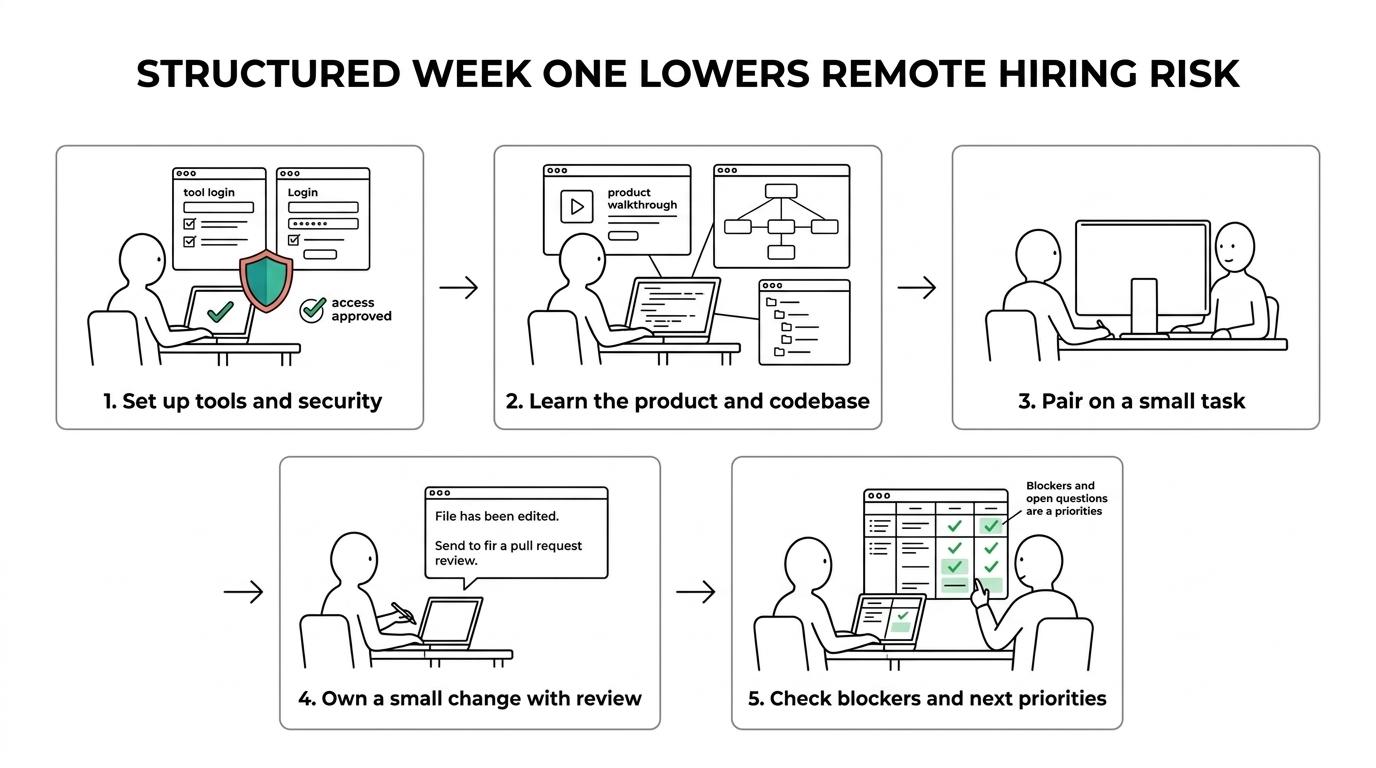
Week one should therefore be structured. Day one is environment setup, tool access, and security briefing. Day two is product walkthrough, architecture map, and codebase orientation. Day three is shadowing or paired work on a small task. Day four is an independently owned change with review. Day five is a checkpoint on blockers, open questions, and next-week priorities.
MIT HR recommends sharing a task calendar after training and onboarding sessions. That is a smart move for engineering teams because it turns vague expectations into visible milestones. Another useful insight comes from Gallup’s later work: onboarding should not be treated as only the first 30 days, but as a year-long process. For remote developers, that means the first week is just the start of structured ramp-up.
Fraz Khan ships production-ready digital products, so onboarding should cover architecture, release process, and business context, not just a Slack invite.
What matters in the first 30 to 90 days after hire?
The first 90 days should show increasing ownership, safer decisions, and better communication artifacts. Output matters, but so do review quality, documentation, and how the developer handles access and ambiguity.
By day 30, look for basic reliability. Can the developer run the system locally, ship small changes, write usable updates, and follow your review process? By day 60, ownership should expand. They should understand the product surface, name technical risks, and contribute ideas that improve speed or stability. By day 90, they should be handling a meaningful stream of work with less supervision.
Do not measure success only by raw ticket count. A remote developer who closes many issues but creates weak tests, unclear pull requests, or security shortcuts is borrowing trouble from the future. A better scorecard includes shipped work, code review signal, documentation quality, incident avoidance, and stakeholder trust.
The strongest indicator is simple: if priorities change, can this person adapt without chaos? Remote development works best when the developer can translate change into written plans, scoped tasks, and clean execution. That is the point where hiring stops feeling like risk and starts feeling like capacity.
Decision checklist
- Role written as outcomes and ownership, not only a stack list
- Nine interview questions answered with recent, concrete examples
- Identity, references, and written remote work agreement checked
- Least-privilege access plan and security briefing before production systems
- First-week onboarding calendar and 30/60/90 ownership checkpoints defined
FAQ
What is the single best question to ask a remote developer?
Ask what they would ship in the first 30, 60, and 90 days — then ask for a recent example of how they documented decisions and handled access. Planning plus operating habits beat a pure coding quiz.
Should I hire a freelance full-stack developer or an agency?
Choose a freelance full-stack developer when you need one accountable owner and direct access to the person writing the code. Choose an agency when you need multiple functions, formal account management, or larger throughput.
What should be in a remote work agreement?
Worksite, equipment, security duties, communication windows, and incident reporting — plus payment terms and IP. Write it before the first commit.
How do I onboard a remote developer in week one?
Day 1 setup and security, day 2 product and architecture context, day 3 paired work, day 4 an owned change with review, day 5 a checkpoint. Share a task calendar so expectations are visible.
Related guides
Related services
Want a clear Next.js / full-stack quote?
For US, UK, and Australia founders — see packages & pricing, Hire MVP developer, or start a project brief.
Related: Hire MVP developer · Hire Next.js developer · Hire Node.js developer · Hire full-stack / freelance full-stack developer · For US startups · For UK startups · For Australian startups · Services & pricing · all resources